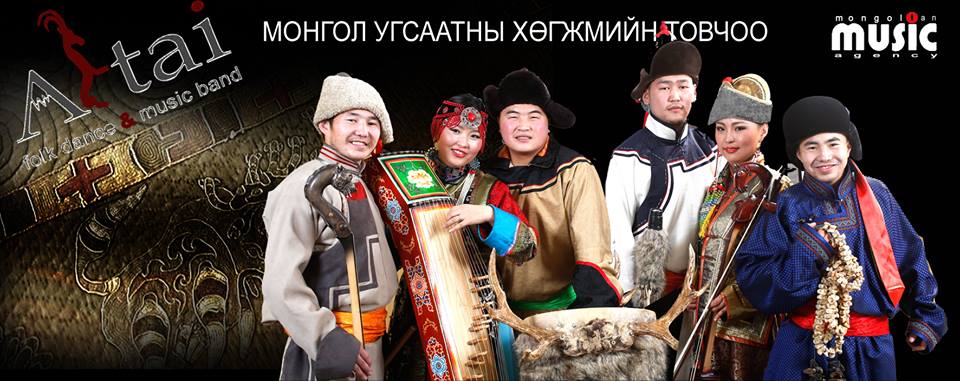
ALTAI- band had about 50 works in our song catalogue and mostly create our performances with the Western Mongolian region’s bii biyelgee dance, khuumii, ikhyel khuur and the unique tatlag technique on the morin khuur.
Bii biyelgee– Bii biyelgee originates from the Altai region of Mongolia and has been widely popular among the Huns as a dancing style. This has been confirmed by the research of Mongolian Cultural historians. Traditional dancers Ganzorig Balgan and his brother Gurbazar Balgan have inherited the biyelgee dance from their ancestors who passed it down 14 generations.
Khuumii– this traditional throat singing has been noted to be popular since the time of the Huns. Historians have documented that the Hun nomads used to howl like wolves. Altai band khuumii singer Davaadalai Munkhbat is a 4th generation singer, who has inherited the throat singing from his ancestors.
Tatlag– a unique style of playing that has been refined for centuries on the instruments morin khuur and ikhel. This style has particularly developed in the Western Region of Mongolia. For the Altai band this playing style blends perfectly well with the bii biyelgee dance. The tatlag has developed over the years as a solo improvisational performance style among the nomads within their homes. The tatlag is such a refined style of playing with a very unique sound and requires the player to possess not only a remarkable technique but powerful spirit. Many professional musicians find it difficult listen this style of playing and replicate the sound. The tatlag style can embody and express a variety of characteristics and movements such as the bull, horse and camel. Mongolian traditional praise artists also widely use tatlag in their performances. Our very own Adyakhuu Sanchir is a 4th generation morin khuur and ikhyel player. Altai band is developing and utilizing tatlag style in all of our creations.
Some of Altai band’s achievements:
Received Olonkho “Nomadic music” festival’s top song award as well as 4 other awards. This festival was held in Yakut, Buriatia in 2014.
The president of Mongolia Mr. Elbegdorj Tsakhia recognized our contribution to the preservation of Mongolian arts/culture and extended a special invitation to our band. When he met us personally he wished us the best in our journey to promote Mongolian traditional dance and music, which cemented us as the ambassadors of this endeavor.
A 1400 year old bow harp ALTAI -Yatga instrument was entrusted to Altai band in 2014.
The official six members of the Altai band are:
1. Adyakhuu Sanchir- Leader of the band, morin khuur player and female vocals 2. Altakhuyag Oyunsuren- Yatga 3. Munkhbat Davaadalai- Khuumii, tsuur, mouth khuur, bamboo khuur, khengereg 4. Tumentogooch Arvan- Khuumii, morin khuur, male vocals, percussion 5. Balgan Gurbazar- Traditional dance, khuumii, mouth khuur, percussion 6. Balgan Ganzorig- Traditional dance, ikhel, percussion. Our artists utilize khuumii (throat singing), morin khuur (horse headed fiddle), bii biyelgee (traditional dance), yatga, Altai yatga, tsuur, arrow khuur, bamboo khuur, percussive instruments of various kind and shagai in their performances. Our band’s members have officially inherited these culturally significant instruments and performances styles for the past 4-12 generations from their ancestors, making our band the only band of its kind in existence today.
Герман хэлээр (Англи орчуулгын гарчигтай хамт) 1981 “Eine tuwinische Geschichte und andere Erzählungen” (A Tuvan Story and other short stories) 1993 “Das Ende des Liedes” (The End of it) 1994 “Der blaue Himmel” (The Blue Sky) 1995 “Zwanzig und ein Tag” (Twenty-One Days) 1996 “Nimmer werde ich dich zähmen können” (Never Will I Tame You) 1997 “Die Karawane” (The Caravan) 1997 “Im Land der zornigen Winde” (In the Land of the Angry Winds, with co-author Amelie Schenk) 1997 “Der siebzehnte Tag” (The Seventeenth Day) 1999 “Die graue Erde” (The Grey Earth) 1999 “Der Wolf und die Hündin” (The Wolf and the Bitch) 2000 “Der weiße Berg” (The White Mountain) 2001 “Dojnaa” 2002 “Tau und Gras” (Dew and Grass) 2004 “Das geraubte Kind” (The Robbed Child) 2008 “Das Menschenwild” 2008 “Die Rückkehr”
Шагнал 1992 Герман хэлээр зохиолоо бичиж дэлхийн утга зохиолын санд хувь нэмрээ оруулсан гадаадын зохиолчид олгодог Аделберт фон Шамиссогийн шагнал. Шамиссогийн шагнал хүртсэн дэлхийн арав дахь, Ази тивийн анхны зохиолч. 1995 Жил бүр герман хэлээр гарсан уран зохиолын шилдэг номд олгодог Пуххаймын шагналыг Дуу амрах цагаар туужийн номоороо 2001 Герман хэлт уран зохиолыг хөгжүүлэхэд дорвитой хувь нэмэр оруулсан учир Х. Додрерийн шагналыг 2002 Улс түмний хооронд соёл түгээх ажилд гаргасан өндөр амжилтыг үнэлэн олгосон ХБНГУ-ын Холбооны Гавъяаны загалмайн одон тус тус хүртэж байсан. 2003 Оросын Холбооны Тува Улсын Урлаг, соёлын гавъяат зүтгэлтэн 2003 Бавар муж улсын уншигчдын нэрэмжит шагнал